When To Take Supplements: Morning vs Night, with Food or on An Empty Stomach
Written By: PillsVital Health Editorial Team
Last Updated: September 2026
When to take supplements depends on the vitamin, mineral or supplement you are using. Some are better taken with food, while others may be absorbed better on an empty stomach. For many supplements, consistency matters more than choosing an exact hour.
So, should you take vitamins in the morning or at night? This guide explains the best time to take common vitamins and supplements, whether they should be taken with food, and which supplements may need to be separated from medicines or other nutrients.
Quick answer: The best time to take supplements depends on the individual supplement. Follow the product label or professional advice, and choose a consistent time that fits your daily routine.
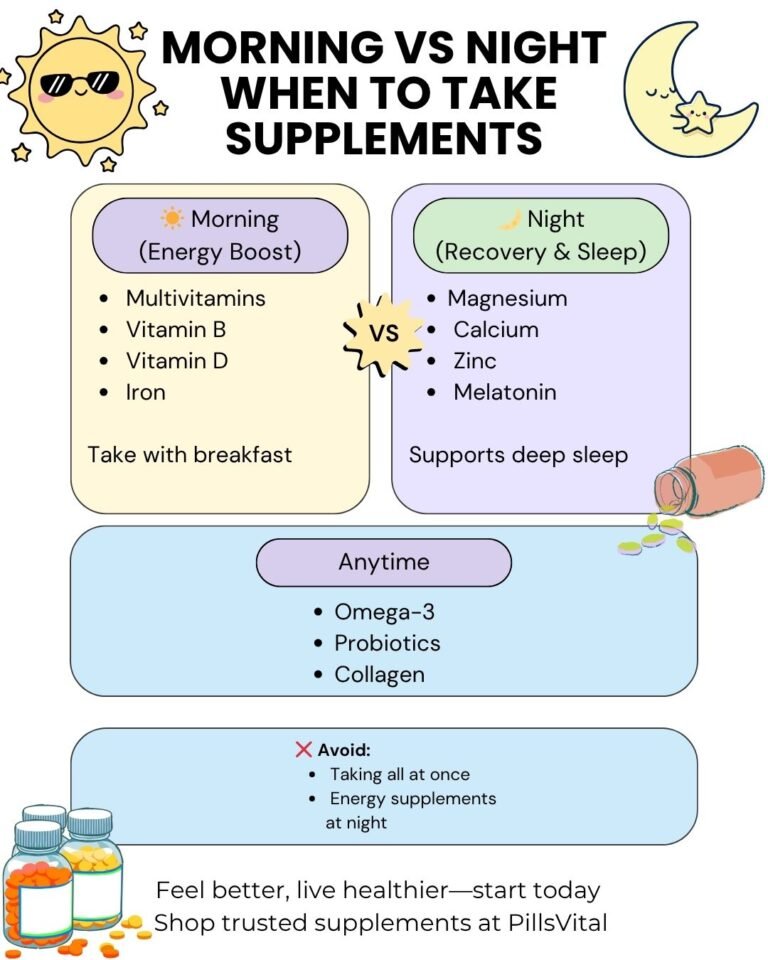
Morning vs Night: When Should You Take Supplements?
| Supplement | Common timing | With food? |
|---|---|---|
| Multivitamin | Morning or with a meal | Usually yes |
| Vitamin B complex | Morning is convenient for many people | With or without food depending on product |
| Vitamin C | Flexible | With food if it causes stomach upset |
| Vitamin D | With a meal containing some fat | Yes |
| Vitamins A, E & K | With a meal containing fat | Yes |
| Iron | Often on an empty stomach if tolerated | Follow product/doctor advice |
| Magnesium | Flexible; some people prefer evening | With food if needed |
| Calcium | Depends on the form and dose | Often with food |
| Omega-3/fish oil | With a meal | Yes |
| Probiotics | Depends on the product | Follow label directions |
What Is the Best Time to Take Supplements?
The best time to take supplements depends on several factors:
- The type of vitamin or mineral
- Whether it is better absorbed with food
- Whether food reduces stomach irritation
- Whether another nutrient affects absorption
- Whether it interacts with a medication
- The formulation of the supplement
- Your individual routine and tolerance
For example, vitamin D is fat-soluble, so taking it with a meal or snack containing some fat can improve absorption.
Iron is different. Ferrous sulfate is generally absorbed best on an empty stomach, although it can be taken with or after food if it causes stomach upset. Tea, coffee, dairy products and eggs can reduce iron absorption when taken at the same time.
Therefore, when to take supplements should be decided based on the specific product rather than a simple morning-versus-night rule.
Is It Better to Take Vitamins in the Morning or at Night?
There is no single best time for every vitamin. The ideal timing depends on the specific nutrient, whether it needs food for absorption, how well you tolerate it and whether it interacts with other medicines or supplements.
Fat-soluble vitamins such as A, D, E and K are generally taken with a meal containing some dietary fat. Other supplements have different instructions. For many people, choosing a consistent time that fits their daily routine is more important than taking a supplement at exactly the same hour every day.
If a supplement’s label or your healthcare professional gives specific instructions, follow those instructions rather than a general morning-or-night rule.
When to Take Vitamins in the Morning
Taking supplements in the morning can be convenient because they can become part of your breakfast routine. If you prefer to build a consistent morning routine around nutrition, movement, and supplements, explore these natural ways to boost energy and learn how vitamin D3 may fit into a healthy daily routine.
Multivitamins
A multivitamin may be easier to remember when taken with a regular meal. However, formulations vary considerably, and there is no standard multivitamin formula. NIH notes that multivitamin/mineral products can contain different combinations and amounts of nutrients.
Follow the instructions on the specific product.
B Vitamins
Some people prefer taking B-complex supplements earlier in the day simply because morning fits their routine.
However, avoid making a blanket claim that everyone must take B vitamins in the morning. The appropriate timing depends on the product and individual circumstances.
Vitamin C
Vitamin C can generally be taken at a convenient time according to the product instructions. If it causes stomach discomfort, taking it with food may be more comfortable.
Iron supplements are often absorbed best on an empty stomach, although taking them with or after food may help if they cause stomach discomfort. See NHS guidance on how to take ferrous sulfate.
When to Take Vitamins at Night
Some people prefer taking certain supplements in the evening because they fit better into their routine or are easier to tolerate with an evening meal. However, nighttime is not automatically the best time for every supplement. If your goal is to create a relaxing evening routine, learn more about sleep supplements and night routine and practical habits that may support better rest.
Magnesium:
Some people prefer taking magnesium in the evening, particularly if it fits their routine. The appropriate timing depends on the specific magnesium product and why it is being used.
Calcium:
Timing depends on the type of calcium supplement and the amount being taken. Some forms are better absorbed with food, while calcium may also need to be separated from certain medicines or minerals.
Zinc
- Helps immunity and recovery
Melatonin
- Helps regulate sleep cycle
NAC 500mg (N-Acetyl Cysteine)
- Supports recovery and overall wellness.
Shop NAC supplements
Good sleep is essential for recovery—learn how it works in this sleep foundation guide
When to Take Vitamin D: Morning or Night?
Vitamin D is one of the most useful examples of why food can matter more than the clock.
Vitamin D is a fat-soluble vitamin, so taking it with a meal or snack that contains some fat can improve absorption. Learn more about vitamin D and how it is absorbed.
Therefore, you can take vitamin D:
- With breakfast
- With lunch
- With dinner
There is no requirement that vitamin D must be taken in the morning.
Example
If you normally eat eggs, avocado, yogurt or another meal containing dietary fat at breakfast, taking vitamin D with that meal may be convenient.
If dinner is your most consistent meal, taking it with dinner can also fit your routine.
Consistency and appropriate use are more important than choosing a specific hour.
Why Supplement Timing Matters
Your body follows a natural circadian rhythm that affects:
- Energy levels
- Hormone release
- Nutrient absorption
Taking supplements at the right time can:
- Improve effectiveness
- Reduce side effects
- Support better overall health
Understanding how vitamins work is important—refer to the official supplement guide from the Office of Dietary Supplements
Fat-Soluble vs Water-Soluble Vitamins
Understanding the difference between these vitamin groups can help explain why supplement timing varies.
Fat-soluble vitamins
The main fat-soluble vitamins are:
- Vitamin A
- Vitamin D
- Vitamin E
- Vitamin K
These vitamins are absorbed along with dietary fat.
For example, vitamin D absorption is enhanced when fat is present in the gut.
Water-soluble vitamins
Water-soluble vitamins include:
- Vitamin C
- B vitamins
Their absorption and use are different from fat-soluble vitamins, so you should not assume that the same timing rule applies to every vitamin.
Should You Take Supplements With Food or on an Empty Stomach?
Usually taken with food
- Vitamin D
- Vitamins A, E and K
- Many multivitamins
- Omega-3
Sometimes taken on an empty stomach
- Iron, depending on tolerance and medical advice
- Certain supplements according to product instructions
If a supplement causes nausea
Explain that taking it with food may improve tolerance, but users should follow the product label/healthcare advice. For this reason, it may be recommended to leave a gap between iron supplements and these foods or drinks. Check NHS advice on taking ferrous sulfate with food and drinks.
Can You Take All Your Vitamins at the Same Time?
Not necessarily.
Some supplements can be taken together, but taking multiple supplements can also increase your total intake of particular nutrients.
NIH notes that multivitamins combined with fortified foods and additional supplements can potentially push intake of certain nutrients above recommended upper limits. Some supplements can interact with prescription or over-the-counter medicines, so check with a healthcare professional before combining supplements with medications. Learn more about supplement safety and interactions.
Some supplements and medicines can also interact.
For example, people taking warfarin should discuss vitamin K-containing supplements with their healthcare professional because vitamin K can reduce the effectiveness of warfarin.
Therefore, don’t automatically combine every vitamin into one daily dose.
Common Supplement Timing Mistakes
Avoid these common errors:
- Taking all supplements together
- Taking vitamins on an empty stomach
- Mixing incompatible supplements
- Taking energy supplements at night
A Simple Supplement Timing Routine
There is no universal schedule, but this example shows how you might organize supplements according to their instructions:
| Time | Example | Reminder |
|---|---|---|
| Breakfast | Multivitamin or B-complex | Follow product instructions |
| With a meal | Vitamin D | Include some dietary fat |
| Away from food if directed | Iron | Avoid tea, coffee and dairy around the dose |
| Dinner | Supplements recommended with food | Follow label |
| Evening | Certain supplements where evening use is appropriate | Check product instructions |
Do not copy this schedule blindly. Your individual needs, medications and supplement formulations may require a different schedule. A consistent evening routine can also make it easier to maintain healthy sleep habits. Explore these evening habits for better sleep and learn how small changes can support nighttime recovery.
Important Safety Information
Dietary supplements can be useful in certain situations, but more is not always better.
Taking multiple supplements can increase the risk of excessive intake of certain vitamins and minerals. NIH also notes that some supplements can interact with medicines.
Before starting a new supplement, speak with a qualified healthcare professional if you:
- Take prescription medicines
- Are pregnant or breastfeeding
- Have a medical condition
- Have kidney or liver problems
- Have been diagnosed with a nutrient deficiency
- Take several vitamins or supplements
- Are considering high-dose supplementation
Never use supplement timing advice as a substitute for prescribed medication instructions.
❓ FAQ
1. What is the best time to take supplements?
There is no single best time to take all supplements. The ideal time depends on the specific vitamin or mineral, whether it should be taken with food, how well you tolerate it, and whether it interacts with medicines or other supplements. Some supplements are best taken with a meal, while others may be taken on an empty stomach. For many people, taking a supplement consistently according to the product label or healthcare professional’s instructions is more important than choosing a particular hour.
2. Is it better to take vitamins in the morning or at night?
It depends on the vitamin. Some vitamins can be taken at either time of day, while others have specific food or timing considerations. Fat-soluble vitamins such as vitamins A, D, E, and K are generally taken with food, while certain mineral supplements have different absorption requirements. If the label or your doctor or pharmacist recommends a specific schedule, follow that guidance rather than a general morning-or-night rule.
3. Should I take vitamins with food or on an empty stomach?
It depends on the supplement. Some vitamins and supplements are better tolerated or absorbed when taken with food, while certain supplements may be recommended on an empty stomach. For example, ferrous sulfate (iron) is generally absorbed best on an empty stomach, although it can be taken with or after food if it causes stomach upset. Tea, coffee, eggs and dairy products can reduce iron absorption when taken at the same time.
Always check the product label because instructions can vary between supplements and formulations.
4. Can I take all my vitamins at the same time?
Not necessarily. Some vitamins and minerals can be taken together, but certain nutrients can interfere with the absorption or effects of other supplements or medicines. Taking multiple products can also increase your total intake of particular nutrients. For example, people taking warfarin should discuss vitamin K-containing supplements with their healthcare professional because vitamin K can affect the medicine’s effectiveness.
If you take several supplements or prescription medicines, ask a pharmacist or healthcare professional to review your complete list.
5. What vitamins are best taken in the morning?
There is no universal list of vitamins that everyone must take in the morning. A multivitamin, vitamin B complex or vitamin C may be convenient to take with breakfast for people who prefer a morning routine, but the appropriate timing depends on the product instructions and individual circumstances.
The most important point is to follow the label and take the supplement consistently. If a supplement causes stomach discomfort, taking it with food may help, depending on the product.
6. What vitamins are best taken at night?
There is no general rule that vitamins work better when taken at night. Some people choose to take certain supplements in the evening because they fit better into their daily routine or are easier to tolerate with an evening meal.
For supplements such as magnesium, the appropriate timing depends on the specific product and why it is being used. Do not assume that taking a vitamin at bedtime will automatically improve sleep or increase its effectiveness.
7. Should vitamin D be taken in the morning or at night?
Vitamin D does not have to be taken at a specific time of day. It can be taken in the morning, afternoon or evening. Because vitamin D is fat-soluble, taking it with a meal or snack containing some fat can help the body absorb it.
Choose a time that fits your routine and follow the dosage and directions on the product label or advice from your healthcare professional.
8. Can I take supplements before bed?
Some supplements can be taken before bed, but whether bedtime is appropriate depends on the specific supplement. Certain products may need to be taken with food, while others may have different absorption or interaction considerations.
Before taking a supplement at bedtime, check its label and consider whether it could interact with medicines or other supplements you use. If you are unsure, ask a pharmacist or healthcare professional.
9. Does the time of day affect vitamin absorption?
Sometimes, but it depends more on the specific nutrient, formulation and whether it is taken with food than simply whether it is morning or night.
For example, vitamin D is fat-soluble and is better absorbed when taken with a meal or snack containing some fat. Iron absorption is affected by other foods and beverages, and ferrous sulfate is generally absorbed best on an empty stomach.
Therefore, there is no universal “best time” that applies to every vitamin or supplement.
10. How should I schedule multiple supplements?
Start by checking the instructions for each supplement and identifying whether it should be taken with food, on an empty stomach, or separated from other medicines or nutrients. Then create a simple schedule that you can follow consistently.
For example, a general routine might look like:
- Breakfast: Supplements that are directed to be taken with breakfast or that fit comfortably into your morning routine.
- Lunch or dinner: Fat-soluble vitamins or other supplements recommended with food.
- Evening: Supplements that your product instructions allow you to take at this time.
- As specifically directed: Iron, prescription medicines, or supplements with special timing or interaction requirements.
Do not create a schedule based only on general online advice if you take prescription medicines or several supplements. A pharmacist or healthcare professional can check the complete combination for potential interactions. NIH notes that supplements can interact with medicines and that high doses or taking many different supplements can increase the risk of problems.
Bottom Line: When Should You Take Supplements?
The best answer to “when to take supplements?” is: it depends on the supplement.
Some are best taken with food, some may be better absorbed away from certain foods, and others can be taken whenever they fit your routine.
Instead of following a blanket morning-or-night rule:
Check the label → consider food and absorption → check medicine interactions → choose a consistent routine.
If you’re unsure about combining supplements or changing the timing of a supplement or medicine, ask a pharmacist or healthcare professional.
Related Health Resources
-

Cholecalciferol 60000 IU Capsules (Vitamin D3)
$66.00 – $183.00Price range: $66.00 through $183.00 This product has multiple variants. The options may be chosen on the product page
🩺 Related Guides