
Pirfenidone 200 mg and 400 mg Tablets for IPF: Complete Guide
Medically reviewed/updated: August 2026
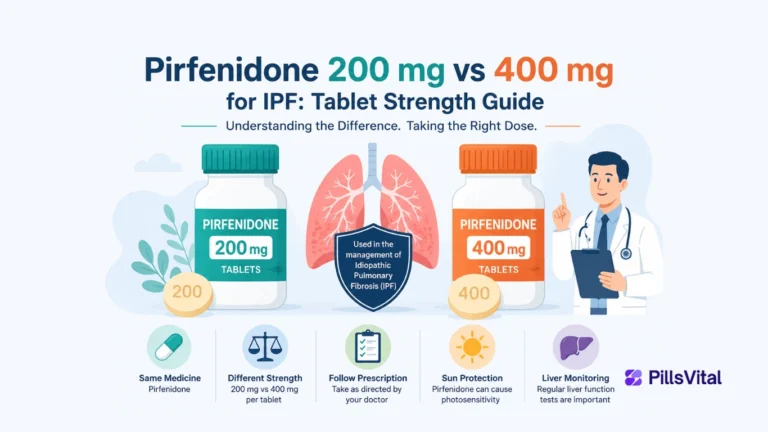
When researching treatment for idiopathic pulmonary fibrosis (IPF), patients may encounter pirfenidone tablets in different strengths. Pirfenidone 200 mg and 400 mg tablets for IPF contain the same active medicine, but each tablet provides a different amount of pirfenidone.
This difference can create an important question: What is the difference between pirfenidone 200 mg and 400 mg tablets, and how does tablet strength relate to the prescribed treatment regimen?
The answer is more nuanced than simply saying that one tablet is “stronger.” Tablet strength describes the amount of active ingredient in an individual tablet. The prescribed daily regimen depends on the specific product, treatment stage, applicable prescribing information, and the patient’s medical circumstances. For a broader overview of how the medicine works, its approved uses, dosage considerations, and common adverse effects, see our complete guide to pirfenidone.
This guide focuses specifically on pirfenidone tablet strengths, how 200 mg and 400 mg formulations compare, and what patients should understand before using or switching between them.
Important: Pirfenidone is a prescription medicine. This article is educational and should not be used to determine your personal dose. Always follow the instructions provided by your healthcare professional and the prescribing information for your specific product.
What Does the Strength of a Pirfenidone Tablet Mean?
The number printed on a tablet indicates how much active ingredient it contains.
For example:
- A 200 mg pirfenidone tablet contains 200 mg of pirfenidone.
- A 400 mg pirfenidone tablet contains 400 mg of pirfenidone.
Therefore, one 400 mg tablet contains twice the amount of pirfenidone found in one 200 mg tablet.
However, the strength of an individual tablet should not be confused with the total amount prescribed per day.
Tablet strength vs daily dose
These are two different concepts.
Tablet strength:
The amount of pirfenidone contained in one tablet.
Daily dose:
The total amount of medicine taken according to the prescribed schedule.
For this reason, seeing “200 mg” or “400 mg” on the packaging does not tell you how many tablets you should take during a day.
What Are Pirfenidone 200 mg Tablets?
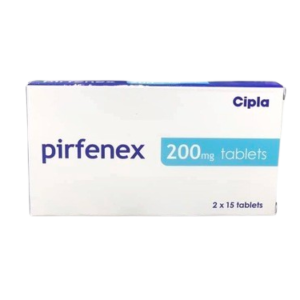
Pirfenidone 200 mg tablets contain 200 mg of pirfenidone per tablet. If you are researching a branded 200 mg formulation, you can learn more about Pirfenex 200 mg tablets and its product information.
Depending on the manufacturer and country, a 200 mg formulation may be available as part of a prescribed pirfenidone treatment regimen.
A patient should not assume that taking one 200 mg tablet represents the complete recommended dose for IPF.
The appropriate number of tablets and dosing frequency must come from the prescription and the product information applicable to that formulation.
What Are Pirfenidone 400 mg Tablets?
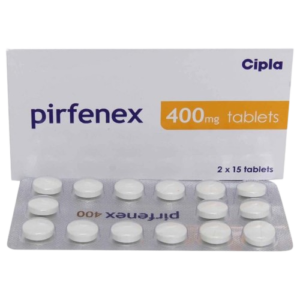
Pirfenidone 400 mg tablets contain 400 mg of pirfenidone per tablet. For information about the branded 400 mg formulation, see Pirfenex 400 mg tablets.
Because each tablet contains twice the amount found in a 200 mg tablet, fewer tablets may sometimes be needed to provide a particular amount of pirfenidone.
However, this does not mean that patients should independently replace one strength with another.
Different formulations can have different approved instructions, and treatment may involve dose titration or adjustment.
Pirfenidone 200 mg vs 400 mg: Quick Comparison
| Feature | Pirfenidone 200 mg | Pirfenidone 400 mg |
|---|---|---|
| Active ingredient | Pirfenidone | Pirfenidone |
| Amount per tablet | 200 mg | 400 mg |
| Relative amount | 1× | 2× |
| Used for IPF when prescribed | Yes | Yes |
| Same active ingredient | Yes | Yes |
| Automatically interchangeable | No | No |
| Should the patient choose the strength? | No | No |
The key difference is the amount of pirfenidone in each tablet.
Neither strength should automatically be considered better.
Is 400 mg Better Than 200 mg for IPF?
Not necessarily.
A 400 mg tablet contains more pirfenidone than a 200 mg tablet, but a higher amount per tablet does not automatically mean a better treatment outcome.
Treatment effectiveness depends on the prescribed regimen and the patient’s individual circumstances.
The appropriate formulation may depend on:
- The patient’s treatment stage
- The specific product
- Available tablet strengths
- Tolerability
- Other medicines
- Liver function
- The prescribing instructions applicable to the product
The goal is to use the appropriate prescribed regimen, not simply the tablet with the higher number.
Can Two 200 mg Tablets Equal One 400 mg Tablet?
In terms of the amount of active ingredient:
2 × 200 mg = 400 mg
So two 200 mg tablets contain the same total amount of pirfenidone as one 400 mg tablet.
But mathematical equivalence does not automatically mean that patients should substitute one formulation for another.
The exact formulation, dosing schedule, tablet instructions, and treatment plan still matter.
If your prescription specifies a particular tablet strength, use that strength as directed rather than changing it yourself.
Can One 400 mg Tablet Replace Two 200 mg Tablets?
Not automatically.
Although the total amount of pirfenidone would be equivalent, the substitution should only be made when it is appropriate for the prescribed regimen and the specific product.
Before changing strengths, speak with your doctor or pharmacist.
This is particularly important when switching between products from different manufacturers or products intended for different markets.
Why Can Pirfenidone Have Different Tablet Strengths?
Medication manufacturers may produce different strengths for practical dosing purposes.
The strengths available to patients can vary between:
- Countries
- Manufacturers
- Brands
- Regulatory markets
- Formulations
For example, some authorized pirfenidone products in Europe use 267 mg, 534 mg, and 801 mg strengths, while other markets or products may use different formulations. European authorization and product information for pirfenidone can be reviewed through the European Medicines Agency.
This is why patients should always use the prescribing information supplied with their particular product rather than assuming that all pirfenidone tablets follow the same strength system.
How Does Pirfenidone Dosing Work for IPF?
Pirfenidone treatment is not simply based on selecting a tablet with the desired number of milligrams.
Some approved regimens use gradual dose escalation when treatment begins.
For example, U.S. prescribing information for pirfenidone tablets describes an initial titration period before reaching the recommended maintenance regimen.
Use this for your dosing, administration, liver monitoring, drug interactions, smoking, and photosensitivity sections. Official Pirfenidone Prescribing Information — DailyMed
An additional current DailyMed label is available here: Pirfenidone Tablets — DailyMed
The U.S. tablet regimen is:
- Days 1–7: 267 mg three times daily
- Days 8–14: 534 mg three times daily
- Day 15 onward: 801 mg three times daily
The U.S. prescribing information also instructs patients to take pirfenidone with food.
These strengths are specific to that approved formulation and should not be used to independently calculate the dose of another pirfenidone product.
The important lesson is that tablet strength, number of tablets, and total daily dose are separate concepts.
Why Should You Not Calculate Your Own Pirfenidone Dose?
It may seem simple to calculate a dose from the tablet strength, but several factors can affect treatment.
A healthcare professional may need to consider:
- The approved formulation
- The treatment stage
- Previous interruptions
- Side effects
- Liver function
- Kidney function
- Smoking status
- Drug interactions
- Other medical conditions
A patient who has experienced significant adverse effects may also require a different approach from someone starting treatment for the first time.
Therefore, do not use an online article to determine your personal pirfenidone dose.
Pirfenidone 200 mg and 400 mg: Are the Side Effects Different?
Both strengths contain the same active medicine, so they can have the same types of potential adverse effects.
Possible side effects associated with pirfenidone include:
- Nausea
- Diarrhea
- Indigestion
- Abdominal discomfort
- Reduced appetite
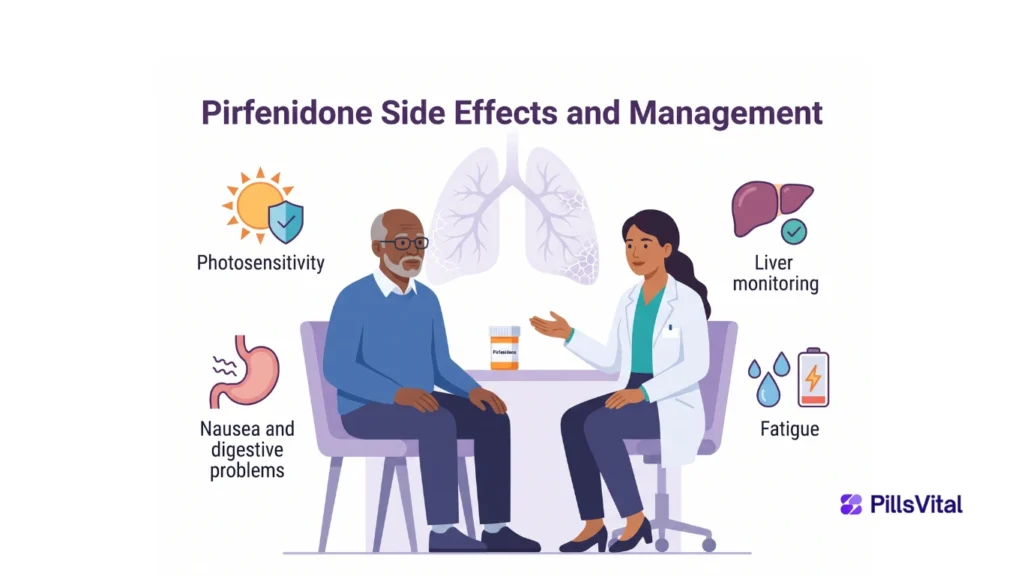
- Fatigue
- Headache
- Dizziness
- Rash
- Photosensitivity
- Liver enzyme abnormalities
The likelihood of experiencing a side effect depends on the individual’s treatment regimen and response.
A higher-strength tablet does not automatically mean that every patient will experience more side effects.
Pirfenidone 200 mg Dosage Considerations
The term pirfenidone 200 mg dosage can refer to the amount contained in an individual tablet, but it should not automatically be interpreted as the patient’s complete daily dosage.
A prescription may specify multiple doses throughout the day or may require gradual dose escalation.
Therefore:
200 mg per tablet ≠ 200 mg per day.
The number of tablets and frequency of administration should always be based on the prescribed regimen for the specific product.
Pirfenidone 400 mg Dosage Considerations
Similarly:
400 mg per tablet ≠ 400 mg per day.
A 400 mg tablet contains 400 mg of pirfenidone, but the patient’s prescribed total daily amount may be different.
Never increase or decrease the number of 400 mg tablets without professional guidance.
This distinction is especially important when comparing products from different manufacturers or countries.
Why Is Food Important When Taking Pirfenidone?
For the U.S. tablet formulation, pirfenidone is taken with food.
Taking the medicine with food is part of the recommended administration instructions and may also help reduce some gastrointestinal problems.
Patients should follow the instructions supplied with their specific product because formulations can differ between markets
Pirfenidone and Sun Exposure
Photosensitivity is an important consideration during pirfenidone treatment.
The medicine can make the skin more sensitive to sunlight and ultraviolet exposure.
Patients may be advised to:
- Limit unnecessary direct sunlight
- Use broad-spectrum sunscreen
- Wear protective clothing
- Avoid tanning beds and sunlamps
- Report significant skin reactions
Sun protection should be part of the routine while taking pirfenidone.
Does Pirfenidone Require Liver Monitoring?
Yes.
Pirfenidone can cause elevations in liver enzymes and, in rare cases, serious liver injury.
Healthcare professionals generally assess liver function before treatment and monitor it during therapy according to the applicable prescribing information. The pirfenidone prescribing information provides detailed recommendations for liver-function testing and monitoring during treatment.
Blood tests may include measurements such as:
- ALT
- AST
- Bilirubin
Contact a healthcare professional if you develop symptoms that could indicate liver problems, including yellowing of the skin or eyes, dark urine, unusual fatigue, loss of appetite, or persistent nausea.
Pirfenidone and Drug Interactions
Pirfenidone can interact with certain medicines.
Some interactions can alter the amount of pirfenidone in the body.
Particular attention may be required with medicines affecting the CYP1A2 metabolic pathway.
Before starting pirfenidone, tell your healthcare professional about:
- Prescription medicines
- Over-the-counter medicines
- Vitamins
- Herbal products
- Dietary supplements
Never assume that a medicine or supplement is safe to combine with pirfenidone simply because it is available without a prescription.
Pirfenidone and Smoking
Smoking can affect pirfenidone exposure.
Tobacco smoke can increase CYP1A2 activity, which may reduce exposure to pirfenidone.
If you smoke, tell your healthcare professional. Your smoking status may be relevant when evaluating your treatment.
Stopping smoking is also generally important for protecting lung health.
What If You Miss Pirfenidone Doses?
Do not automatically double the next dose.
Follow the instructions supplied with your medicine or contact your healthcare professional for advice.
Longer interruptions may require a gradual restart rather than immediately returning to the previous dose.
For example, U.S. prescribing information contains specific instructions regarding restarting treatment after prolonged interruptions.
If you have missed several doses, ask your healthcare professional how to restart safely.
Can Pirfenidone 200 mg and 400 mg Be Used Together?
They may potentially be used as part of a prescribed regimen when the specific product and treatment plan call for different strengths.
However, this should not be decided by the patient.
Combining tablet strengths can change the total amount of medicine taken and may result in an unintended dose.
Always follow the prescribed number of tablets and dosing times.
How Are Pirfenidone Tablet Strengths Different Around the World?
This is an important consideration for people researching pirfenidone internationally.
Not every country has exactly the same tablet strengths.
For example, regulatory information for certain European products lists 267 mg, 534 mg, and 801 mg tablets.
Other pirfenidone products may be marketed in different strengths.
Therefore, if you move between countries or purchase a different brand, do not assume that the new tablet strength follows exactly the same dosing instructions as your previous product.
Ask a doctor or pharmacist to confirm the correct regimen.
Pirfenex 200 mg and Pirfenex 400 mg
Pirfenex is a brand of pirfenidone.
Products such as Pirfenex 200 mg and Pirfenex 400 mg contain the same active ingredient, pirfenidone, while differing in the amount contained in each tablet.
The 200 mg product contains 200 mg per tablet, while the 400 mg product contains 400 mg per tablet.
The product strength should always be checked on the packaging before use.
If your prescription specifies a particular strength, make sure the product you receive matches the prescribed formulation.
When Should You Speak With a Healthcare Professional?
Contact your healthcare professional if you experience:
- Severe or persistent nausea
- Significant diarrhea
- Severe rash
- Serious sun sensitivity
- Yellowing of the skin or eyes
- Dark urine
- Unusual or severe fatigue
- Significant appetite loss
- New or worsening breathing difficulty
- Symptoms of an allergic reaction
Do not attempt to manage serious adverse effects by simply switching from 400 mg to 200 mg or changing the number of tablets yourself.
Frequently Asked Questions About Pirfenidone
What is the difference between pirfenidone 200 mg and 400 mg?
The main difference is the amount of active ingredient in each tablet. A 200 mg tablet contains 200 mg of pirfenidone, while a 400 mg tablet contains 400 mg.
Is pirfenidone 400 mg twice as strong as 200 mg?
A 400 mg tablet contains twice as much pirfenidone as a 200 mg tablet. However, this does not mean it is twice as effective or automatically more appropriate.
Can I take two 200 mg tablets instead of one 400 mg tablet?
Two 200 mg tablets contain 400 mg of pirfenidone, but you should only make this substitution if it is consistent with your prescribed treatment and the specific product instructions.
Can I switch from pirfenidone 200 mg to 400 mg?
Do not change strengths without professional advice. The appropriate number of tablets and dosing schedule may need to be adjusted.
Is 200 mg a standard pirfenidone dose for IPF?
Not necessarily. The amount in one tablet should not be confused with the complete prescribed dose. Approved regimens vary according to the formulation and market.
Is 400 mg the standard maintenance dose for IPF?
Not necessarily. Maintenance dosing depends on the specific approved formulation and prescribing instructions.
Does pirfenidone cure IPF?
No. Pirfenidone is not a cure for idiopathic pulmonary fibrosis. Its role is to help slow disease progression.
Does pirfenidone need to be taken with food?
For the U.S. tablet formulation, yes. Follow the instructions for your specific product.
Does pirfenidone affect the liver?
Yes. Pirfenidone can increase liver enzymes and rarely cause serious liver injury, which is why monitoring is important.
Can pirfenidone cause sun sensitivity?
Yes. Photosensitivity and rash are recognized adverse effects, so sun protection is important during treatment.
Final Takeaway
Pirfenidone 200 mg and 400 mg tablets for IPF contain the same active ingredient but provide different amounts of pirfenidone per tablet.
The most important distinction is that tablet strength is not the same as the prescribed daily dose. A 400 mg tablet contains twice as much pirfenidone as a 200 mg tablet, but this does not mean that one strength is universally better or that patients can freely substitute between them.
Pirfenidone treatment may involve dose titration, food-related administration instructions, liver monitoring, sun protection, and assessment of potential drug interactions.
Because available strengths and formulations can vary internationally, always follow the prescribing information for the exact product you are using.
If you have been prescribed Pirfenex or another pirfenidone product, confirm the tablet strength and dosing schedule with your healthcare professional before starting treatment or making any change.
Related Health Resources
-
Pirfenex 200 mg Tablet
$70.00 – $190.00Price range: $70.00 through $190.00 This product has multiple variants. The options may be chosen on the product page -
Pirfenex 400 mg Tablet
$95.00 – $285.00Price range: $95.00 through $285.00 This product has multiple variants. The options may be chosen on the product page
💜 Related Guides About Pirfenidone


Dr. Emily Carter specializes in evidence-based health education and wellness content. She focuses on simplifying complex medical topics related to cancer awareness, nutrition, preventive healthcare, skincare, and lifestyle wellness for readers worldwide.
This content is reviewed for medical accuracy, clarity, and alignment with current public health research. The article is intended for educational and informational purposes only and should not replace professional medical advice, diagnosis, or treatment.