
How Often Should You Deworm a Horse? Complete Horse Deworming Schedule
Medically reviewed/updated: August 2026
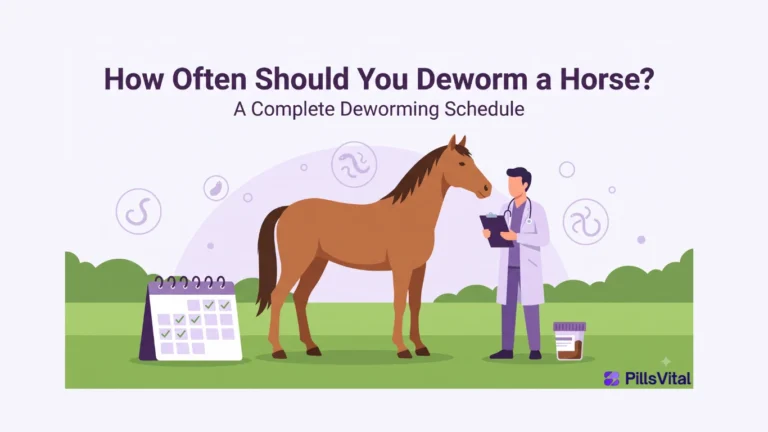
If you own or care for a horse, one of the most important parasite-control questions is: how often should you deworm a horse?
The answer is not as simple as giving every horse a dewormer every few months. Modern equine parasite management focuses on the horse’s age, parasite exposure, fecal egg-count results, previous treatment response, and the risk of anthelmintic resistance.
The American Association of Equine Practitioners (AAEP) recommends moving away from routine, fixed-interval deworming for every horse. Instead, parasite-control programs should use fecal egg counts, targeted treatment and periodic testing to determine whether a dewormer is working effectively.
This guide explains how horse deworming schedules work, when testing is useful, and what factors should influence the choice and timing of treatment.
How Often Should You Deworm a Horse?
There is no single deworming schedule that is appropriate for every horse.
A horse’s parasite-control plan may depend on:
- Age
- Health status
- Pasture management
- Number of horses sharing the property
- Parasite exposure
- Fecal egg-count results
- Previous deworming history
- Local parasite resistance
- Effectiveness of previous treatments
Instead of automatically treating every horse at the same interval, modern recommendations favor identifying horses that require treatment and selecting an effective product for the parasites that need to be controlled.
The AAEP recommends baseline treatments and targeted treatments based on fecal egg counts and individual risk rather than frequent blanket deworming.
Why Horses Do Not All Need the Same Deworming Schedule
Horses differ significantly in how many parasite eggs they shed.
Some horses are consistently low egg shedders, while others contribute substantially more eggs to pasture contamination.
This means two horses living in the same barn may not require exactly the same parasite-control strategy.
Age also matters.
Young horses can have different parasite risks than mature adults, while older horses may require individualized consideration based on health and previous parasite exposure.
The goal is therefore not to create a calendar that says:
“Every horse gets dewormed every three months.”
Instead, the goal is to develop a parasite-control program that responds to the horse and its environment.
What Is a Fecal Egg Count?
A fecal egg count (FEC) is a laboratory examination of a horse’s manure to estimate the number of parasite eggs being shed.
FEC can help identify horses that are higher egg shedders and can support decisions about targeted parasite treatment.
However, fecal egg counts have limitations.
They do not detect every parasite, and some important parasite stages may not produce eggs that appear in a routine fecal examination.
Therefore, a normal or low FEC does not automatically mean that a horse has no parasites.
Instead, FEC should be considered one component of a broader parasite-control strategy.
What Is a Fecal Egg-Count Reduction Test?
A fecal egg-count reduction test (FECRT) is used to evaluate how well a dewormer has worked.
Fecal samples are collected before treatment and again after treatment according to the veterinarian’s testing protocol.
The results can help determine whether the parasite population remains susceptible to the medication.
This is particularly important because a horse may receive the correct product and administration yet still have significant parasite shedding if resistance is present.
The AAEP recommends annual efficacy testing to help identify reduced dewormer effectiveness on a farm or within a group of horses.
How Often Should You Deworm a Foal?
Foals require a different approach from mature horses.
Young horses can be particularly susceptible to certain parasites, including Parascaris species.
Parascaris infections can become clinically important in young horses and may cause respiratory or gastrointestinal problems when parasite burdens are substantial.
However, resistance to some commonly used anthelmintics has also been reported in Parascaris populations.
Therefore, choosing a dewormer for a foal should not simply involve using whatever product was given to adult horses.
A veterinarian can help determine:
- Which parasites are most relevant
- When treatment should occur
- Which product is appropriate
- Whether fecal testing is useful
- Whether treatment effectiveness should be checked
Deworming Young Horses
Young horses can have different parasite risks than adults.
Their parasite-control program should consider:
- Age
- Exposure to contaminated pasture
- Previous treatments
- Parascaris risk
- Strongyle exposure
- Fecal testing
- Local resistance patterns
As horses mature, their parasite-control strategy may change.
This is another reason why a single deworming calendar should not automatically be applied to every horse in a stable.
Deworming Adult Horses
Adult horses often have a greater ability to develop immunity or partial resistance to some parasites compared with young horses.
However, adult horses can still carry and shed parasites.
The important question is therefore not simply:
“Is my horse an adult?”
It is:
“What is this horse’s current parasite risk, and what evidence do I have about its parasite burden and previous treatment effectiveness?”
Fecal egg counts can help identify higher shedders and support targeted treatment decisions.
What About Senior Horses?
Senior horses may require a more individualized parasite-control program.
Age alone does not mean a horse needs more frequent deworming.
Instead, consider:
- Overall health
- Body condition
- Dental health
- Previous parasite exposure
- Fecal egg counts
- Medication history
- Veterinary assessment
If an older horse has unexplained weight loss, diarrhea, poor body condition or other health changes, do not assume worms are the only possible cause.
A veterinarian should evaluate the horse before repeated deworming is used as a diagnostic strategy.
Seasonal Horse Deworming: Does Timing Matter?
Seasonal parasite exposure varies depending on geography, climate, pasture conditions and parasite species.
This means there is no universal “spring deworming” or “winter deworming” rule that works everywhere.
Historically, many horse owners followed seasonal schedules automatically.
Modern parasite management instead emphasizes determining which parasites are relevant at a particular time and whether treatment is necessary.
Your local climate can influence:
- Parasite development
- Pasture contamination
- Larval survival
- Grazing exposure
- Seasonal transmission patterns
For this reason, a parasite-control program developed with a local equine veterinarian can be more useful than copying a generic online calendar.
Spring Deworming
Spring can bring increased grazing activity as horses spend more time on pasture.
However, increased grazing does not automatically mean every horse should immediately receive a dewormer.
Consider:
- Recent fecal egg-count results
- Previous treatment
- Pasture management
- Horse age
- Local parasite conditions
Testing can help determine whether treatment is actually necessary.
Summer Parasite Management
During summer, parasite exposure can vary significantly by climate and pasture conditions.
Good pasture management can reduce contamination.
Useful practices include:
- Regular manure removal
- Avoiding excessive stocking density
- Rotational grazing where practical
- Preventing overgrazing
- Maintaining appropriate pasture conditions
Deworming should work alongside these management measures rather than replacing them.
Fall and Winter Considerations
Fall and winter parasite-control decisions depend heavily on geography and the parasites relevant to the area.
Some parasite stages may survive environmental conditions differently depending on climate.
Instead of assuming that every horse needs a seasonal treatment, discuss the appropriate timing with your veterinarian.
A targeted approach can reduce unnecessary exposure to dewormers and help slow the development of resistance.
Why Dewormer Resistance Changes the Schedule
One of the biggest reasons modern recommendations have changed is anthelmintic resistance.
Parasites can develop genetic characteristics that allow some individuals to survive treatment.
When the same medication is repeatedly used against a parasite population, susceptible parasites may be eliminated while resistant parasites survive and reproduce.
Over time, the medication can become less effective.
Resistance has been documented among important equine parasites and affects several commonly used dewormer classes.
This means giving a dewormer more frequently does not necessarily improve parasite control.
In some situations, unnecessary treatment can actually contribute to the resistance problem.
Should You Rotate Horse Dewormers?
Blindly rotating dewormers on a predetermined calendar is no longer considered the ideal approach.
The AAEP recommends moving away from blind rotation of anthelmintic classes and instead using fecal testing and efficacy testing to guide treatment decisions. Current AAEP parasite-control recommendations emphasize targeted treatment and monitoring of anthelmintic effectiveness rather than blindly rotating dewormer classes.
Different drug classes can still have important roles.
The key is determining:
- Which parasite needs to be controlled?
- Which active ingredients are effective against it?
- Is resistance suspected?
- Does the horse actually require treatment?
- Has previous treatment been shown to work?
This is more useful than simply switching from one product to another every few months.
Common Horse Dewormer Ingredients
Several active ingredients are used in equine parasite control.
Fenbendazole
Fenbendazole is a benzimidazole anthelmintic.
It has established veterinary use, but resistance among equine strongyles can limit its effectiveness in some populations.
Therefore, fenbendazole should not automatically be assumed to work simply because it has historically been used for horse worms.
Ivermectin
Ivermectin is a macrocyclic lactone.
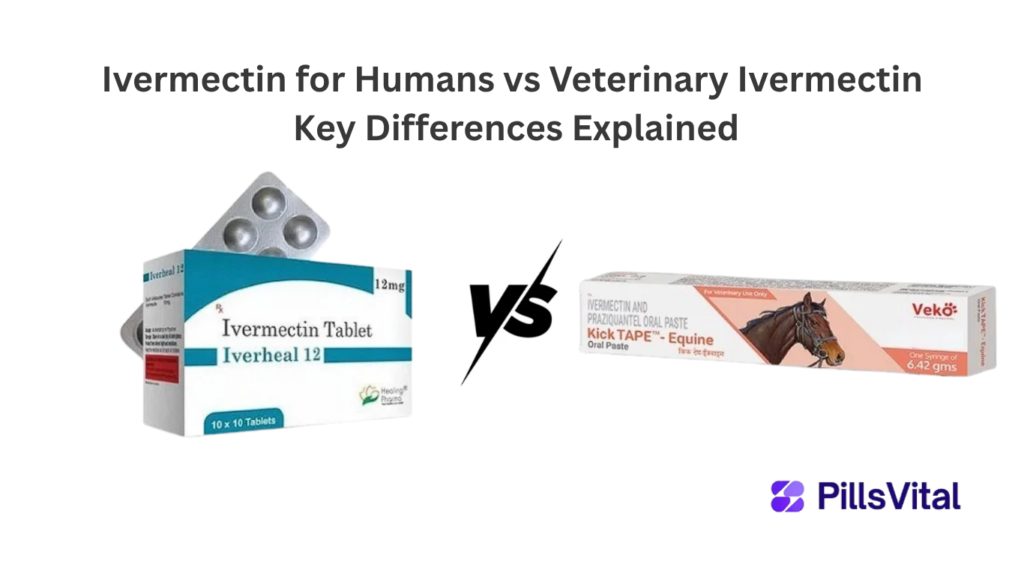
It has broad activity against several important equine parasites, but resistance is an increasing concern. If you are considering ivermectin for horses, it is also important to understand the differences between animal formulations and human medicines; see our guide to human vs veterinary ivermectin for more information. Human vs Veterinary Ivermectin: Key Differences
Praziquantel
Praziquantel is particularly important for tapeworm control.
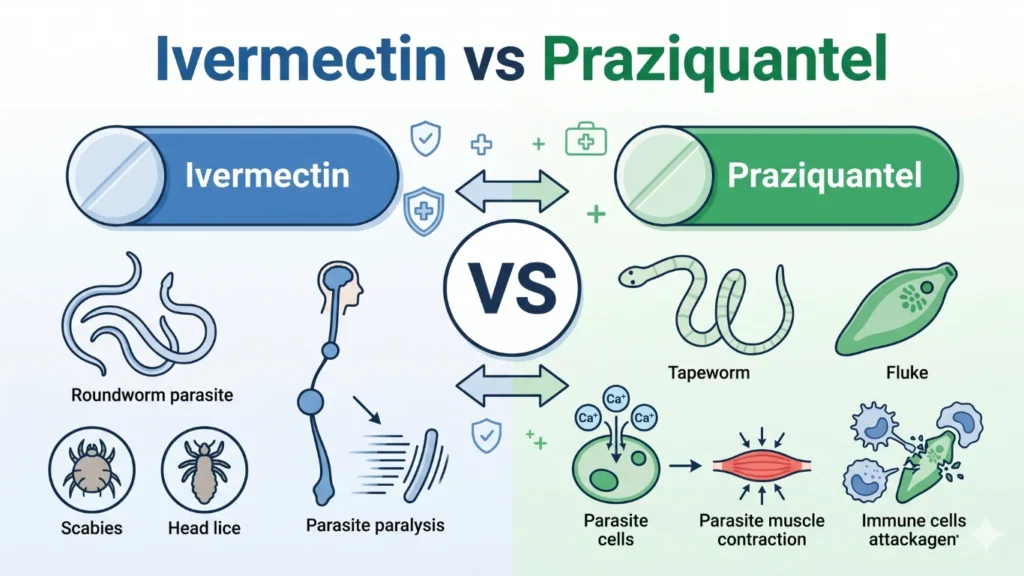
It is commonly combined with another equine dewormer, such as ivermectin or moxidectin.
You can read more about comparing these ingredients in our guide to the best horse dewormer for worms.
How to Choose the Right Dewormer
The right product depends on more than the horse’s weight. If you want to compare commonly discussed horse dewormers, read our guide to the best horse dewormer for worms and learn how fenbendazole, ivermectin and praziquantel differ. The FDA’s guidance on equine anthelmintics provides information on evaluating the effectiveness of deworming medications used in horses.
Consider:
1. Parasite type
Different active ingredients have different parasite coverage.
2. Horse age
Foals and young horses may have different parasite risks from adults.
3. Fecal egg count
Testing can help determine egg-shedding level.
4. Resistance
A product may be less effective if local parasites have developed resistance.
5. Previous treatment
Knowing which products have been used recently can help prevent unnecessary repetition.
6. Product label
Always follow the specific equine product’s approved instructions.
7. Veterinary guidance
A veterinarian can help interpret testing and select an appropriate treatment strategy.
Horse Deworming Schedule: A Practical Framework
Rather than following a universal calendar, use a decision-based approach.
| Stage | What to consider |
|---|---|
| Baseline assessment | Horse age, health, management and parasite history |
| Fecal testing | Determine egg-shedding level |
| Risk assessment | Pasture, herd size and environmental exposure |
| Treatment decision | Treat when indicated by risk and testing |
| Efficacy check | Use FECRT when appropriate |
| Future planning | Adjust the parasite-control program based on results |
This approach is more flexible than treating every horse at exactly the same interval.
How Pasture Management Can Reduce Worm Exposure
Dewormers are only one part of parasite management.
Pasture management can also reduce parasite transmission.
Remove Manure Regularly
Removing manure from paddocks can reduce contamination.
Avoid Overcrowding
High stocking density can increase parasite exposure.
Prevent Overgrazing
Horses grazing extremely close to the ground may increase their exposure to infective parasite larvae.
Consider Rotational Grazing
Appropriate pasture rotation can help manage parasite exposure when implemented correctly.
Separate Young Horses Where Practical
Because young horses can have different parasite risks, managing them separately from older horses may sometimes be beneficial.
Signs That May Indicate a Parasite Problem
Parasite infections can sometimes occur without obvious clinical signs.
Possible signs of significant parasite burden may include:
- Weight loss
- Poor body condition
- Dull coat
- Diarrhea
- Reduced performance
- Colic
- Poor growth in young horses
- Pot-bellied appearance in some young animals
However, these signs are not specific to worms.
A horse showing these symptoms should be evaluated by a veterinarian rather than automatically being given repeated dewormer treatments.
Common Horse Deworming Mistakes
Mistake 1: Deworming on a fixed calendar
Every horse does not have the same parasite burden.
Mistake 2: Assuming a dewormer always works
Resistance can cause treatment failure.
Mistake 3: Using the same product repeatedly
Repeated exposure can increase selection pressure for resistant parasites.
Mistake 4: Ignoring fecal testing
Testing can provide valuable information for targeted parasite control.
Mistake 5: Treating symptoms without diagnosis
Weight loss or diarrhea can have many causes.
Mistake 6: Using products incorrectly
Always follow the approved label for the specific equine product.
Mistake 7: Using another species’ medication
Do not substitute human or livestock formulations for an equine product unless specifically directed by a veterinarian.
What Happens If You Deworm a Horse Too Often?
Frequent unnecessary treatment can contribute to anthelmintic resistance.
It may also expose the horse to medication without providing a meaningful parasite-control benefit.
The objective of modern parasite management is therefore effective treatment when needed, not maximum treatment frequency.
Reducing unnecessary treatments can help preserve the effectiveness of available anthelmintic medications.
Can You Deworm a Horse Without a Fecal Egg Count?
A fecal egg count is not required before every treatment in every situation.
There are circumstances where a veterinarian may recommend treatment based on age, parasite risk, season, clinical concerns or other factors.
However, FEC is an important tool for identifying egg-shedding patterns and developing a targeted long-term parasite-control program.
It should be combined with veterinary assessment rather than treated as a complete diagnostic test.
How Long Does a Horse Need to Be Monitored After Deworming?
The appropriate timing for post-treatment testing depends on the specific dewormer and the purpose of the test.
A FECRT should follow an appropriate veterinary or laboratory protocol because testing too early or too late can make results difficult to interpret.
If treatment appears ineffective, do not simply administer another product immediately.
Speak with an equine veterinarian about whether resistance, incorrect administration, reinfection or another factor could explain the result.
Frequently Asked Questions
How often should I deworm my horse?
There is no universal interval for every horse. Current parasite-control recommendations favor individualized treatment based on factors such as age, risk, fecal egg counts and treatment effectiveness rather than routine fixed-interval deworming.
Can fenbendazole treat tapeworms in horses?
Your horse’s deworming frequency should be determined as part of an individualized parasite-control plan. A veterinarian can help interpret fecal testing and determine when treatment is appropriate.
Can horses be dewormed too often?
Yes. Unnecessary repeated treatment can increase selection pressure for drug-resistant parasites without necessarily improving parasite control.
Do all horses need to be dewormed at the same time?
Not necessarily. Horses within the same facility can have different egg-shedding levels and parasite risks.
What is the best horse dewormer?
There is no universally best dewormer. The appropriate product depends on the parasites involved, horse characteristics and local resistance.
Is ivermectin enough for horse worms?
Ivermectin has activity against several important equine parasites, but it does not provide identical coverage for every parasite. Resistance can also reduce effectiveness.
Does praziquantel treat horse worms?
Praziquantel is particularly important for tapeworm control. It is commonly combined with another equine anthelmintic to provide broader parasite coverage.
Is fenbendazole still effective for horses?
Fenbendazole can be effective against susceptible parasites, but resistance—particularly among equine strongyles—can limit its effectiveness in some populations.
Should I rotate horse dewormers?
Do not blindly rotate dewormer classes according to a fixed calendar. Current recommendations emphasize targeted treatment and efficacy testing.
Can a fecal egg count detect all horse worms?
No. FEC has important limitations and does not detect every parasite or every life stage. Veterinary assessment may require additional diagnostic approaches.
Final Takeaway
So, how often should you deworm a horse?
The most accurate answer is:
As often as the horse’s individual parasite-control plan indicates—not simply according to a fixed calendar.
Age, parasite exposure, fecal egg counts, previous treatments, local resistance and treatment effectiveness should all influence the plan.
Modern equine parasite management focuses on targeted treatment, fecal testing, appropriate pasture management and monitoring for anthelmintic resistance.
If you are unsure which product or schedule is appropriate for your horse, consult an equine veterinarian before treatment.
Related Health Resources
-
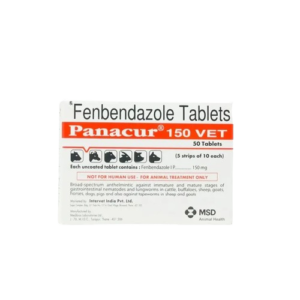
Fenbendazole 150mg (Panacur) Tablets
$35.00 – $135.00Price range: $35.00 through $135.00 This product has multiple variants. The options may be chosen on the product page -
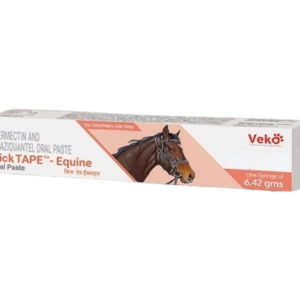
Ivermectin And Praziquantel Oral Paste
$48.00 – $135.00Price range: $48.00 through $135.00 This product has multiple variants. The options may be chosen on the product page
🐴 Related Horse Deworming & Ivermectin Guides

Dr. Emily Carter specializes in evidence-based health education and wellness content. She focuses on simplifying complex medical topics related to cancer awareness, nutrition, preventive healthcare, skincare, and lifestyle wellness for readers worldwide.
This content is reviewed for medical accuracy, clarity, and alignment with current public health research. The article is intended for educational and informational purposes only and should not replace professional medical advice, diagnosis, or treatment.