
Fenbendazole vs Ivermectin + Praziquantel for Horses: Which Dewormer Is Right?
Medically reviewed/updated: August 2026
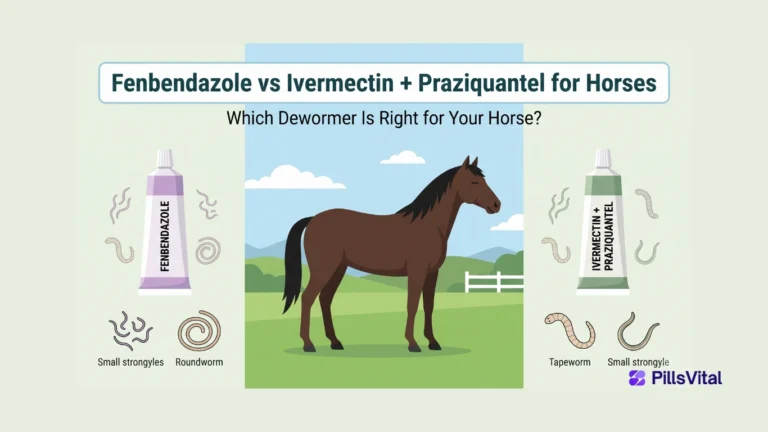
Fenbendazole vs ivermectin vs praziquantel for horses is not simply a matter of choosing the “strongest” dewormer. These medications belong to different anthelmintic classes and have different parasite targets. The right parasite-control approach depends on the horse’s age, parasite exposure, fecal egg-count results, local resistance patterns, previous treatments, and veterinary assessment.
Fenbendazole is a benzimidazole anthelmintic, ivermectin is a macrocyclic lactone, and praziquantel is an isoquinoline compound used primarily for equine tapeworm control. Because their activity differs, one medication should not automatically be substituted for another.
Current equine parasite-control guidance also discourages blindly rotating dewormers or giving adult horses routine treatments at fixed intervals throughout the year. Instead, parasite control should be based on surveillance, targeted treatment, and testing of dewormer effectiveness. Horse owners comparing different deworming options can explore our Veterinary Medicine category for additional information about veterinary antiparasitic products.
Important: This article is educational and does not provide an individualized deworming schedule or dosing instructions for a horse. Product labels vary by country and formulation. A veterinarian should determine which treatment is appropriate for an individual horse.
Quick Comparison: Fenbendazole vs Ivermectin vs Praziquantel
| Medication | Drug class | Main role in equine parasite control | Important limitation |
|---|---|---|---|
| Fenbendazole | Benzimidazole | Targets several gastrointestinal nematodes | Resistance among equine parasites can reduce effectiveness |
| Ivermectin | Macrocyclic lactone | Broad activity against several equine nematodes and bots | Does not provide tapeworm control by itself |
| Praziquantel | Isoquinoline | Primarily targets tapeworms | Narrower spectrum than ivermectin |
| Ivermectin + praziquantel | Two classes combined | Broad nematode/bot coverage plus tapeworm activity | Still does not eliminate the need for parasite surveillance |
Merck Veterinary Manual identifies macrocyclic lactones such as ivermectin, benzimidazoles such as fenbendazole, and praziquantel-containing products as important components of equine parasite control, but their parasite coverage is different.
What Is Fenbendazole?
Fenbendazole belongs to the benzimidazole class of anthelmintic drugs.
In horses, fenbendazole is used against certain gastrointestinal nematodes. Its activity can include parasites such as strongyles and ascarids, depending on the product, parasite species, and local resistance pattern.
One important reason fenbendazole should not automatically be considered an alternative to ivermectin is anthelmintic resistance.
Equine parasites have developed resistance to several dewormer classes. The American Association of Equine Practitioners recommends testing the effectiveness of anthelmintic products rather than assuming that a particular drug will work because it worked previously.
Fenbendazole also should not be viewed as a universal horse dewormer. For example, Merck notes that benzimidazoles have no efficacy against equine tapeworms.
What makes fenbendazole different?
The most important point is that fenbendazole and ivermectin belong to different drug classes.
That does not automatically mean one is better.
The useful question is:
Which parasite is being targeted, and is the selected medication still effective against that parasite on this farm?
What Is Ivermectin?
Ivermectin belongs to the macrocyclic lactone class.
In equine parasite control, ivermectin has broad activity against several nematode parasites and is also used for bot control. Merck describes macrocyclic lactones as having broad activity against important equine nematodes and notes their role in controlling adult and migrating larval stages of susceptible parasites.
However, ivermectin is not a complete tapeworm treatment when used alone.
This distinction is important because horse owners sometimes assume that a broad-spectrum dewormer covers every important internal parasite.
It does not.
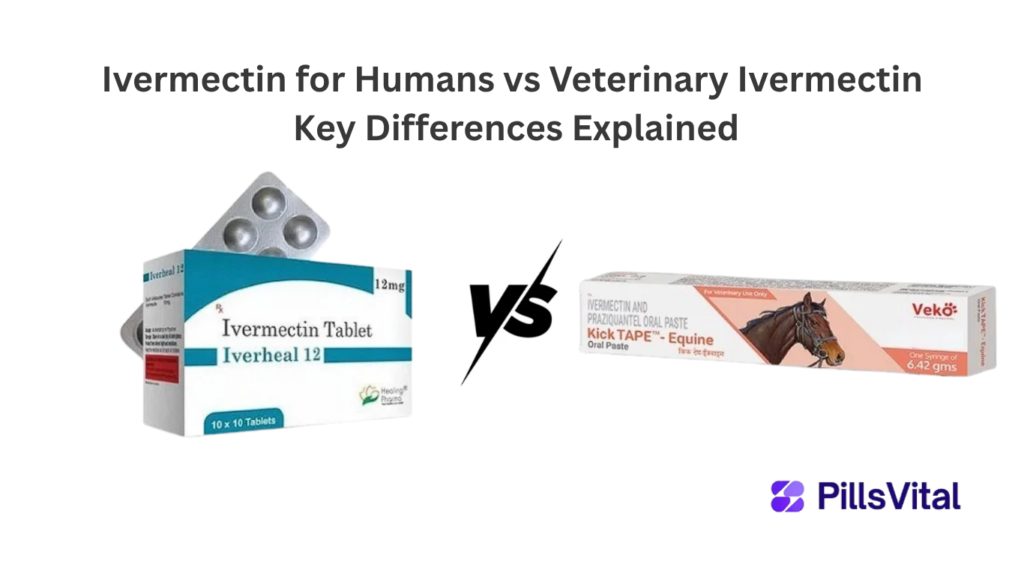
Praziquantel is used specifically for tapeworm control, and it is commonly combined with ivermectin or moxidectin in equine products. For an explanation of how formulations, concentrations, intended use, and safety considerations can differ, see our guide to human vs veterinary ivermectin differences.
Is ivermectin always effective?
No.
Parasite resistance to macrocyclic lactones is an increasing concern. Merck’s updated 2025 guidance reports resistance among several important equine parasite groups and emphasizes routine evaluation of anthelmintic effectiveness.
This is why repeatedly administering ivermectin without considering parasite surveillance may be an ineffective long-term strategy.
What Is Praziquantel?
Praziquantel is an isoquinoline anthelmintic with a much narrower role in equine parasite control than ivermectin.
Its primary purpose in horses is tapeworm control.
The equine tapeworm of particular concern is Anoplocephala perfoliata.
Unlike ivermectin, praziquantel is specifically useful for targeting tapeworms. Merck identifies praziquantel as a cestocide approved for horses and notes that it is available in combination with ivermectin or moxidectin.
Why is praziquantel often combined with ivermectin?
The combination provides complementary parasite coverage.
In simple terms:
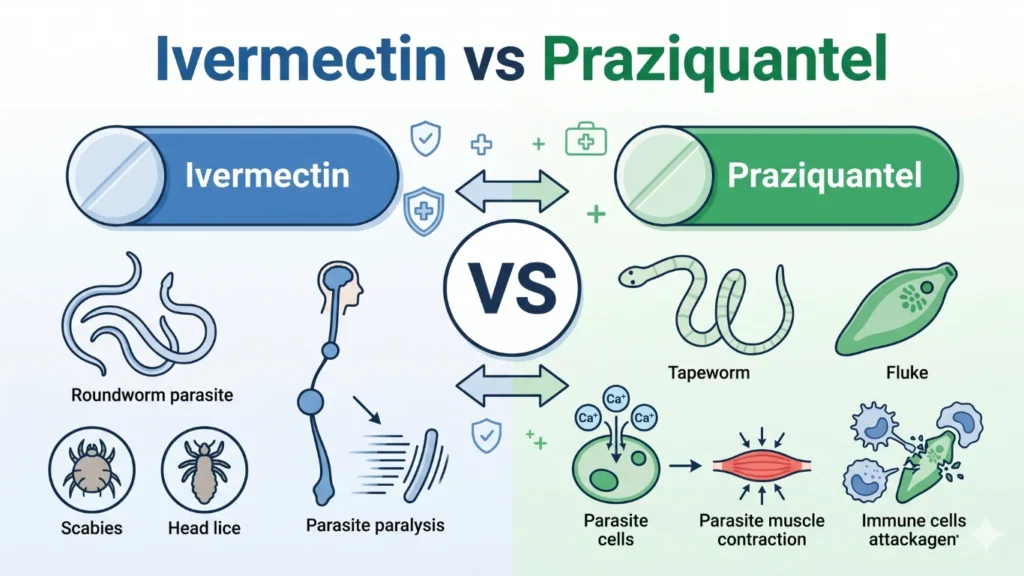
Ivermectin → several susceptible nematodes and bots
Praziquantel → tapeworms
Therefore, an ivermectin-plus-praziquantel product can address parasite groups that ivermectin alone does not.
However, broader coverage does not mean the combination eliminates every parasite or guarantees effectiveness. Resistance and parasite-specific susceptibility still matter.
Why Does the Praziquantel Component Matter?
One of the biggest reasons horse owners consider an ivermectin + praziquantel product is the inclusion of praziquantel.
Tapeworms are different from many of the nematode parasites commonly discussed in equine deworming.
A product containing ivermectin may provide useful activity against susceptible nematodes, but ivermectin alone is not the same as an ivermectin + praziquantel combination when tapeworm control is required.
Praziquantel adds an ingredient specifically used for tapeworm control.
Therefore, when a veterinarian believes tapeworm exposure is relevant, the presence of praziquantel can be an important factor when selecting a product.
Fenbendazole vs Ivermectin for Horses
Fenbendazole and ivermectin differ in both drug class and parasite activity.
Fenbendazole
- Benzimidazole
- Used against susceptible gastrointestinal nematodes
- May be used in specific treatment protocols under veterinary guidance
- Effectiveness can be limited by resistance
Ivermectin
- Macrocyclic lactone
- Broad activity against several susceptible equine nematodes
- Used for bot control
- Does not control tapeworms by itself
The important takeaway is that fenbendazole is not simply a weaker or stronger version of ivermectin.
They work differently and have different resistance profiles.
Merck reports that equine parasites have developed resistance to multiple anthelmintic classes, making surveillance and efficacy testing increasingly important
Ivermectin vs Praziquantel for Horses
This is one of the easiest comparisons to understand.
Ivermectin
Primarily contributes broad control of susceptible nematodes and bots.
Praziquantel
Primarily contributes tapeworm control.
Therefore, these medications should not normally be viewed as direct substitutes.
A horse requiring tapeworm control may need a praziquantel-containing treatment, depending on the veterinarian’s assessment and the horse’s risk factors.
The AAEP’s 2024 guidelines recommend including praziquantel for tapeworm control at least annually in certain mature-horse situations, while additional treatment should be based on evidence of infection and risk.
Fenbendazole vs Praziquantel for Horses
Fenbendazole and praziquantel have very different roles.
Fenbendazole → primarily nematode-targeting activity
Praziquantel → tapeworm-targeting activity
This means replacing one with the other without identifying the parasite can leave the horse inadequately protected.
For example, using fenbendazole does not automatically provide tapeworm control.
Similarly, praziquantel should not be expected to function as a broad-spectrum substitute for an ivermectin-containing product.
Fenbendazole vs Ivermectin + Praziquantel for Horse Parasites
The most useful way to compare these products is by considering parasite groups rather than asking which product is universally stronger.
1. Strongyles
Strongyles are among the most important gastrointestinal parasites affecting horses.
However, susceptibility to anthelmintics varies.
Fenbendazole may have activity against susceptible strongyles, but resistance to benzimidazoles is widespread in many equine parasite populations.
Ivermectin may also provide activity against susceptible strongyles, although reduced susceptibility and resistance are concerns in equine parasite management.
Therefore, the choice should not be based solely on the drug’s historical reputation.
2. Small Strongyles
Small strongyles, also called cyathostomins, are particularly important in adult horses.
Resistance to several anthelmintic classes has been documented, making indiscriminate or overly frequent deworming problematic.
A veterinarian may consider:
- Fecal egg-count results
- Previous deworming history
- Local resistance patterns
- Horse age
- Pasture exposure
- Individual parasite risk
before recommending a treatment.
3. Roundworms
Roundworms, particularly Parascaris spp., are especially relevant in young horses.
Resistance patterns can differ from those seen in adult-horse parasite populations.
For this reason, young horses should not simply be treated using the same assumptions applied to mature horses.
Veterinary guidance is particularly important when selecting an anthelmintic for foals and young horses.
4. Tapeworms
This is one of the clearest differences between the options.
Praziquantel is included in certain equine dewormers specifically because of its activity against tapeworms.
Fenbendazole is not generally selected as the primary tapeworm-control ingredient.
Therefore, if tapeworm control is a specific objective, a product containing an appropriate tapeworm-active ingredient may be considered by the veterinarian.
5. Bots
Horse bots are associated with botfly larvae.
Ivermectin-containing horse products may have activity against bot larvae when used according to the product label.
Fenbendazole is not generally considered the equivalent choice for bot control.
This illustrates why comparing dewormers requires looking at the entire parasite spectrum, rather than comparing drug names alone.
Fenbendazole vs Ivermectin + Praziquantel: Which Has Broader Coverage?
If the question is simply:
“Which option covers more parasite groups?”
an ivermectin + praziquantel combination generally has a broader intended spectrum because it combines two active ingredients with different antiparasitic activity.
Ivermectin contributes activity against susceptible nematodes and certain other parasites.
Praziquantel adds tapeworm activity.
Fenbendazole, by comparison, is primarily considered in relation to susceptible gastrointestinal nematodes.
But broader coverage does not automatically mean that a combination product is the correct product for every horse.
The goal of parasite control is not to expose horses to unnecessary treatments. It is to maintain effective parasite control while reducing selection pressure for resistance.
Which Is Better for Strongyles?
There is no universally correct answer.
Fenbendazole can be effective against susceptible parasites, but benzimidazole resistance can significantly affect its usefulness.
Ivermectin can also be effective against susceptible strongyles, but macrocyclic-lactone resistance is an important concern.
The best choice should therefore consider:
- Current parasite burden
- Fecal egg-count results
- Previous treatment history
- Local resistance patterns
- Age and health of the horse
- Product labeling
A veterinarian can help determine whether treatment is necessary and which approved product is appropriate.
Which Is Better for Tapeworms?
When tapeworm control is specifically required, praziquantel is an important ingredient to look for in an appropriately labeled equine product.
This is one reason an ivermectin + praziquantel combination may be selected instead of fenbendazole.
However, the exact treatment schedule should come from the product label and veterinarian rather than from a generic internet deworming calendar.
Horse Age Can Change the Parasite-Control Strategy
A young foal does not have exactly the same parasite-control needs as a mature horse.
Merck’s updated guidance notes that parasite control for foals and weanlings differs substantially from that for mature horses. Younger horses require particular attention to ascarids, while strongyles become increasingly important as horses mature.
Senior horses also deserve individual consideration.
The AAEP notes that horses older than 15 years can become high shedders even when their historical shedding category has been lower, making continued surveillance important.
Therefore, a deworming plan should not simply be copied from another horse.
Which Is Better for Young Horses?
Young horses have different parasite risks from mature horses.
In particular, roundworms can be an important concern in foals and young horses.
Drug resistance patterns can also differ between parasite species.
Because of this, a young horse should not automatically receive the same deworming strategy used for an adult horse.
A veterinarian can help establish an age-appropriate parasite-control program.
What Is a Fecal Egg Count?
A fecal egg count (FEC) measures parasite eggs present in a horse’s manure sample.
It can help veterinarians categorize horses according to their strongyle egg shedding.
The goal is not necessarily to make a horse completely parasite-free.
Instead, modern parasite control aims to keep parasite burdens at manageable levels while reducing unnecessary treatment and slowing resistance.
The AAEP recommends using FECs once or twice a year to help classify horses into low-, moderate-, and high-shedding groups.
Important limitation
A fecal egg count is not a general test for whether a horse is sick from parasites.
The AAEP specifically cautions against using FEC results as a diagnostic test for parasitic disease because egg counts do not directly correspond with every disease-causing parasite stage.
Why Fecal Egg Counts Matter
Modern equine parasite management increasingly emphasizes targeted treatment rather than automatically deworming every horse on the same schedule.
A fecal egg count can provide useful information about the number of eggs being shed by certain gastrointestinal nematodes.
It can help veterinarians and horse owners identify:
- Horses that are higher egg shedders
- Horses that may require treatment
- Whether a deworming treatment produced the expected reduction
- Whether resistance may be affecting treatment effectiveness
A fecal egg count does not detect every type of parasite, so it should not be interpreted as a complete parasite diagnosis.
Tapeworms, for example, require different considerations. The AAEP Internal Parasite Control Guidelines provide detailed guidance on fecal egg counts, fecal egg count reduction testing, parasite risk assessment, and responsible equine parasite control.
What Is Fecal Egg Count Reduction Testing?
A fecal egg count reduction test (FECRT) helps determine whether a dewormer is still effective against the parasites present on a farm.
The basic concept is:
- A fecal egg count is performed.
- The horse receives an appropriate anthelmintic.
- A follow-up fecal egg count is performed at the appropriate interval.
- The change in egg shedding is evaluated.
The AAEP recommends annual FECRT testing to help determine whether the anthelmintics being used remain effective in a particular herd or barn.
This is particularly important because resistance is not identical everywhere.
A drug that performs well in one population may perform poorly in another.
Which Horse Dewormer Is Best?
There is no single “best” dewormer for every horse.
That is one of the most important concepts in modern equine parasite management.
The appropriate product depends on:
- Horse age
- Previous deworming history
- Fecal egg-count results
- Parasite species of concern
- Local parasite resistance
- Geographic region
- Pasture exposure
- Herd or farm management
- Season
- Product labeling
- Veterinary assessment
Merck specifically states that no single parasite-control program is ideal for all horses and that age, population density, region, climate, confinement, and pasture conditions can influence parasite-control decisions.
Why You Should Not Choose a Dewormer Only by “Strength”
Horse owners sometimes search for the:
“strongest horse dewormer.”
But strength is not the best way to evaluate an antiparasitic product.
A more useful question is:
Which approved product is appropriate for the parasite risk affecting this horse?
A product that does not target the relevant parasite is not made more useful simply because it is considered “strong.”
Likewise, unnecessarily frequent treatment can contribute to anthelmintic resistance.
Does More Frequent Deworming Mean Better Protection?
Not necessarily.
Historically, horses were often dewormed on fixed schedules several times per year.
Modern parasite-control strategies increasingly recognize that frequent blanket treatment can contribute to resistance.
The goal is to preserve the effectiveness of available anthelmintic classes for as long as possible.
A targeted strategy may involve:
- Assessing the horse’s parasite risk.
- Performing appropriate fecal testing.
- Identifying higher-risk horses.
- Selecting a suitable approved product.
- Evaluating treatment effectiveness where appropriate.
- Adjusting the parasite-control program over time.
For current recommendations on targeted deworming and reducing anthelmintic resistance, see the AAEP Internal Parasite Control Guidelines.
Fenbendazole vs Ivermectin + Praziquantel: Product Selection Guide
When comparing products, ask these questions:
Question 1: What parasite are you trying to control?
A dewormer should be selected based on the parasite problem rather than the brand name alone.
Question 2: Does the product contain the appropriate active ingredient?
Check the active ingredients and their intended parasite coverage.
Question 3: Has the horse been treated recently?
Recent treatments can affect which drug class is appropriate.
Question 4: Is resistance a concern?
Repeated use of the same drug class can select for resistant parasites.
Question 5: Is tapeworm control needed?
If tapeworms are part of the concern, praziquantel may be an important consideration.
Question 6: What does the product label say?
Always follow the approved horse product’s label.
Question 7: Does the horse need treatment now?
Not every horse requires immediate deworming simply because parasites exist in the environment.
Why You Shouldn't Blindly Rotate Horse Dewormers
For years, horse owners were commonly advised to rotate dewormers on a regular schedule.
Current guidance has moved away from blind rotation.
The AAEP’s updated guidelines recommend discontinuing fixed-interval, year-round deworming and stopping blind rotation of anthelmintic classes. Instead, fecal egg counts and fecal egg count reduction tests should help determine which horses require treatment and whether a product remains effective.
Why?
Because repeated exposure to an ineffective drug can continue selecting for resistant parasites.
Changing from one product to another simply because the calendar says it is time to rotate does not necessarily solve the underlying problem.
Fenbendazole vs Ivermectin + Praziquantel: Which One Should You Choose?
The answer depends on the parasite-control objective.
Fenbendazole may be considered when:
- The target parasites are susceptible to fenbendazole.
- The product is approved for the horse and intended use.
- Resistance is not expected to compromise effectiveness.
- A veterinarian recommends a benzimidazole-based treatment.
Ivermectin + praziquantel may be considered when:
- The veterinarian wants ivermectin-based coverage of susceptible parasites.
- Tapeworm control is also required.
- The combination is approved and appropriate for the horse.
- The product’s label supports the intended use.
The important distinction is that these products should not be viewed as simple substitutes for one another.
Why Anthelmintic Resistance Matters
One of the biggest changes in modern horse parasite management is the increasing concern about drug resistance.
Parasites can become less susceptible to medications after repeated exposure.
Merck’s current equine parasite-control guidance reports resistance involving all major anthelmintic classes used in horses, with multidrug resistance becoming increasingly common in some parasite groups.
Resistance can mean:
- A previously effective product becomes less reliable.
- Repeated treatment may provide diminishing results.
- Different horses on the same property can have different parasite burdens.
- Treatment decisions need to consider local efficacy.
This is why “deworm every two months” is no longer an appropriate universal strategy for adult horses.
How Pasture Management Helps Control Parasites
Deworming is only one part of parasite management.
Good management practices can reduce the number of infective parasites that horses encounter.
Depending on the property, useful measures can include:
- Regular manure removal
- Avoiding excessive pasture stocking
- Appropriate pasture rotation
- Separating younger horses when practical
- Monitoring horses with fecal testing
- Maintaining appropriate nutrition and general health
- Working with a veterinarian on a property-specific parasite plan
Merck emphasizes that parasite control involves both anthelmintic treatment and management of the pasture and stable environment.
Common Horse Deworming Mistakes
Mistake 1: Using the same dewormer every time
Repeated use of the same drug class can increase selection pressure for resistant parasites.
Mistake 2: Deworming every horse on the same schedule
Individual horses can have different parasite burdens and risks.
Mistake 3: Ignoring tapeworm risk
A dewormer that targets nematodes is not automatically equivalent to one containing a tapeworm-active ingredient.
Mistake 4: Assuming every parasite is covered
No single dewormer should be assumed to control every parasite affecting horses.
Mistake 5: Using human or livestock products without veterinary direction
Horse-specific products have specific labeling, formulations, concentrations, and dosing instructions.
Never substitute products simply because they contain a familiar active ingredient. Veterinary formulations should not be assumed to be interchangeable with human medicines; see our guide to human vs veterinary ivermectin differences for more information.
Mistake 6: Guessing the dose
Dosing should be based on the approved product label and accurate estimation of body weight.
How to Reduce Parasite Exposure Beyond Deworming
Deworming is only one part of parasite management.
Good pasture management can help reduce parasite exposure.
Practical measures can include:
- Removing manure from frequently used areas.
- Avoiding excessive stocking density.
- Rotating or resting pastures when practical.
- Managing grazing areas appropriately.
- Avoiding unnecessary blanket treatments.
- Monitoring horses individually.
- Working with a veterinarian on fecal testing.
Good management can reduce the reliance on repeated medication.
Fenbendazole vs Ivermectin + Praziquantel: Final Verdict
There is no universally “best” horse dewormer.
Fenbendazole and ivermectin + praziquantel have different active ingredients and different parasite-control roles.
Fenbendazole may be appropriate for susceptible gastrointestinal nematodes when resistance does not compromise effectiveness.
Ivermectin + praziquantel offers a different spectrum, with ivermectin providing activity against susceptible parasites and praziquantel adding important tapeworm activity.
Therefore, the right question is not:
“Which dewormer is strongest?”
It is:
“Which approved dewormer matches my horse’s current parasite risk?”
A veterinarian can use the horse’s age, history, fecal testing, previous treatments, local resistance information, and product labeling to help make that decision.
When Should a Horse Owner Contact a Veterinarian?
Contact an equine veterinarian if a horse has:
- Recurrent colic
- Unexplained weight loss
- Persistent diarrhea
- Poor body condition
- Reduced performance
- Signs of abdominal discomfort
- Suspected heavy parasite infection
- Repeated treatment failure
- A history of high fecal egg counts
- A need for treatment in a foal or very young horse
- A suspected adverse reaction to a medication
Severe abdominal pain, repeated rolling, sweating, or other signs of acute colic should be treated as an urgent veterinary situation rather than an occasion to administer additional dewormer.
Frequently Asked Questions
Is fenbendazole stronger than ivermectin?
Not necessarily. They belong to different anthelmintic classes and have different parasite activity. The effectiveness of either medication also depends on parasite susceptibility and resistance.
Is ivermectin better than praziquantel?
They are not direct alternatives. Ivermectin has broad activity against susceptible nematodes and bots, while praziquantel primarily targets tapeworms.
Can ivermectin treat horse tapeworms?
Ivermectin alone should not be relied upon for tapeworm control. Praziquantel is the equine drug used specifically for tapeworm treatment.
Can fenbendazole treat tapeworms?
Fenbendazole is not considered an effective treatment for equine tapeworms.
Can a horse receive ivermectin and praziquantel?
Some approved equine products contain both ingredients. However, horse owners should not independently combine separate products without veterinary guidance.
Should I rotate fenbendazole and ivermectin?
Blind rotation is no longer recommended as a universal parasite-control strategy. Current AAEP guidance emphasizes surveillance, targeted treatment, and efficacy testing instead.
How often should an adult horse be dewormed?
There is no single schedule appropriate for every adult horse. Current recommendations favor individualized, surveillance-based parasite control rather than routine fixed-interval deworming throughout the year.
Does a fecal egg count tell me whether my horse has a parasite disease?
Not by itself. FEC is useful for monitoring egg shedding and helping guide parasite-control decisions, but it should not be treated as a general diagnostic test for parasite-related disease.
Key Takeaways
- Fenbendazole, ivermectin, and praziquantel are not interchangeable horse dewormers.
- Fenbendazole belongs to the benzimidazole class and targets susceptible nematodes.
- Ivermectin is a macrocyclic lactone with broad activity against several susceptible equine parasites and bots.
- Praziquantel is primarily used for equine tapeworm control.
- Ivermectin and praziquantel are sometimes combined in approved equine products to provide complementary parasite coverage.
- Anthelmintic resistance is an increasingly important concern.
- Routine blind rotation of dewormers is not recommended.
- Fecal egg counts can help identify shedding patterns.
- FECRT can help determine whether a dewormer remains effective on a particular farm.
- Horse age, environment, geography, previous treatments, and parasite exposure all matter.
- A veterinarian should help develop a parasite-control program for an individual horse.
The goal of modern equine parasite management is not to eliminate every parasite from every horse. The goal is to reduce the risk of clinically important parasitic disease while minimizing unnecessary treatment and slowing the development of resistance.
Related Health Resources
-
Fenbendazole 150mg (Panacur) Tablets
$35.00 – $135.00Price range: $35.00 through $135.00 This product has multiple variants. The options may be chosen on the product page -
Ivermectin And Praziquantel Oral Paste
$48.00 – $135.00Price range: $48.00 through $135.00 This product has multiple variants. The options may be chosen on the product page
🐴 Related Horse Deworming & Ivermectin Guides

Dr. Emily Carter specializes in evidence-based health education and wellness content. She focuses on simplifying complex medical topics related to cancer awareness, nutrition, preventive healthcare, skincare, and lifestyle wellness for readers worldwide.
This content is reviewed for medical accuracy, clarity, and alignment with current public health research. The article is intended for educational and informational purposes only and should not replace professional medical advice, diagnosis, or treatment.